Stroke Class and Stroke Map
The stroke repertoire defines you as a player. It is the stroke vocabulary your brain has learned and can use for games.
Stroke Class Overview
The concept of stroke classes was already introduced under the movement model section.
The key idea of the stroke classes concept is to delineate between the different stroke patterns a player has acquired and is using in their game.
The delineation is based on and reflects how the brain learns, performs, and organizes the movement behavior.
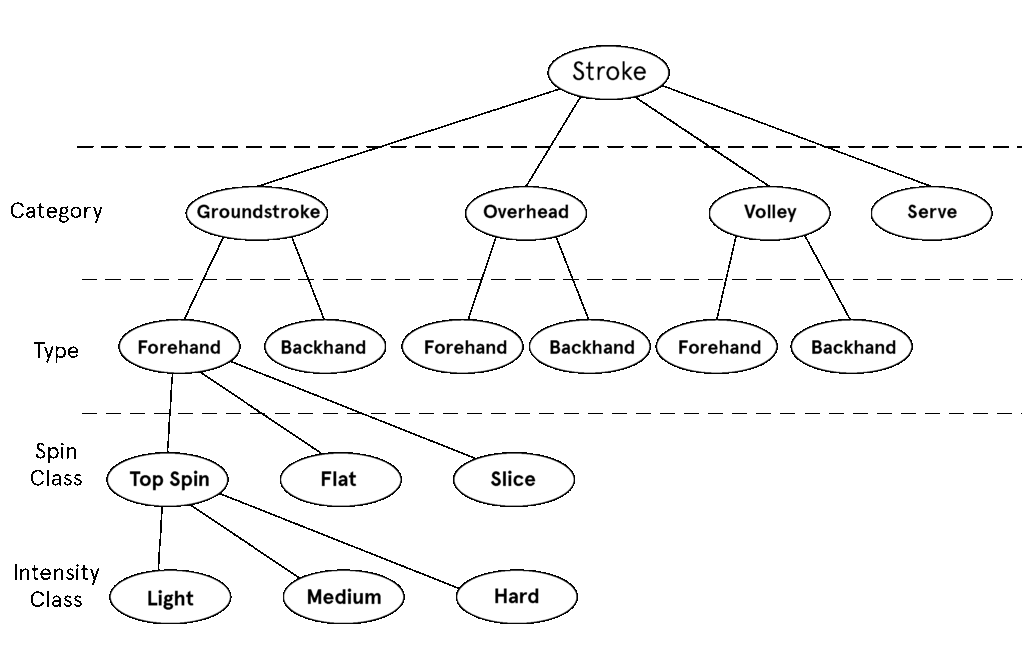
CueMate provides a practical decomposition of the strokes into a finite number of stroke classes that is simple enough for practical application and still captures the relevant features that distinguish classes.
As described in the illustration below, the major delineations are the stroke categories, followed by the stroke types, and then the spin types and intensity levels.
Stroke Classes Significance and Applications
The stroke classes help consider the various strokes, focusing on common characteristics. This is critical for training since it reflects how the brain integrates information for efficient learning. It ultimately creates the knowledge required to employ the proper movement in the right situations.
Furthermore, the systematic organization enabled by the stroke classes also helps deal with the large amounts of data and information arising from movement modeling.
CueMate then organizes the stroke classes into a user interface called the Stroke Map, described below.
The stroke map is one ofCueMate's most central features. It enables the efficient review and navigation of the large amount of information generated from movement data.
Stroke Map Overview
Stroke Map organizes the player's repertoire of strokes into an array or table, with each cell describing a stroke class.There are three primary Stroke Map views, one for each stroke category: Groundstrokes, Volleys, and Serves (Overheads are currently captured under Serves).
Groundstrokes and Volleys Stroke Map
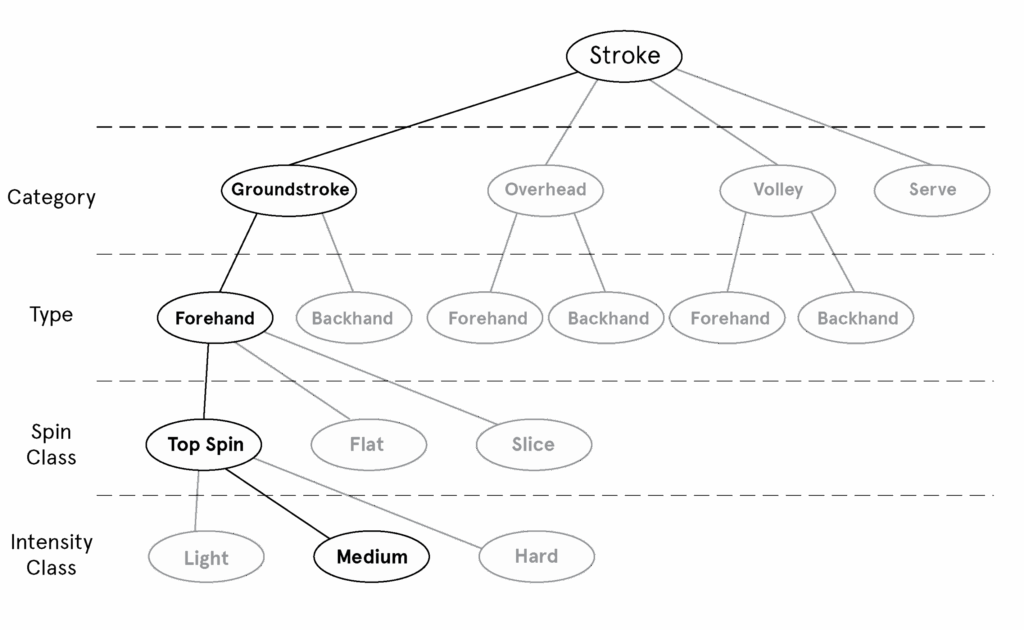
Below is the stroke map for the Groundstrokes forehand and backhand classes.As an example, the ground stroke, forehand, topspin, medium intensity (GFTM) is highlighted in the tree and the stroke map.
Stroke Map Definition
The basic stroke map for ground stroke and volleys has 18 classes (3x3 matrix for each forehand and backhand):
- There are three spin types: topspin, flat, and slice.
- There are three levels of intensity: low, medium, and high.
Each cell on the map represents a specific stroke class, identified by the stroke category, the forehand/backhand, spin type, and intensity level.
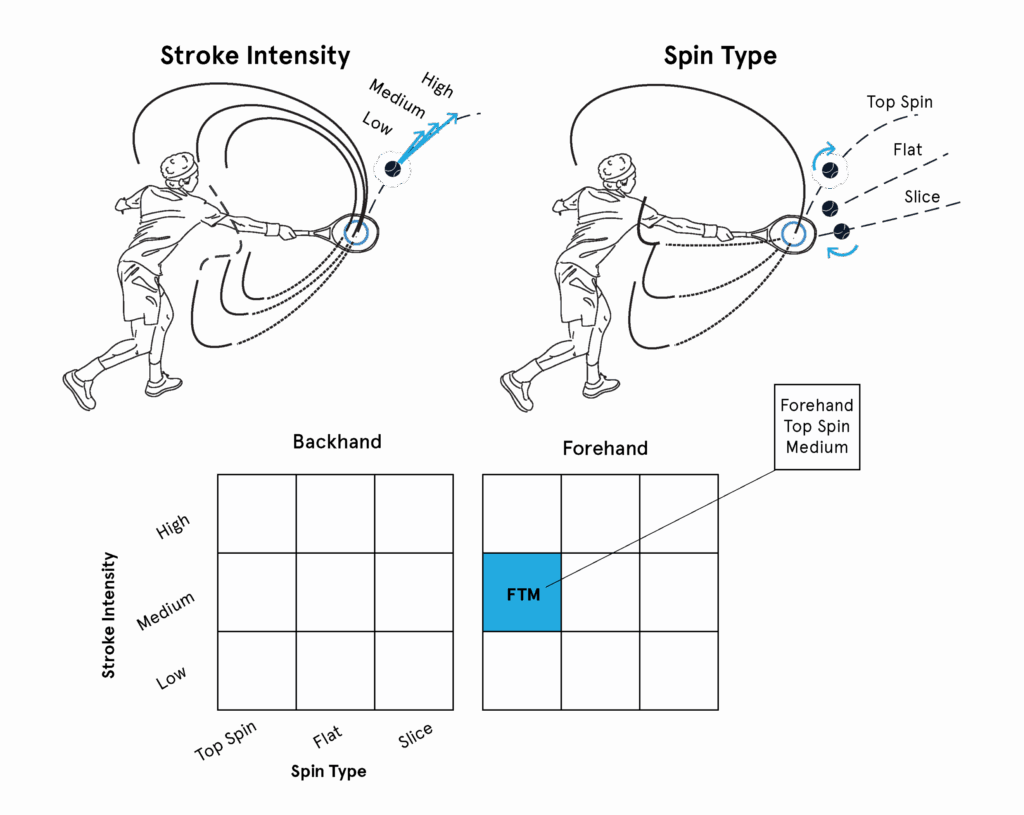
For example, Groundstroke, Forehand, Topspin, Medium (GFTM). For convenience, the stroke classes are abbreviated following this terminology, as shown here in parenthesis. Sometimes, the category abbreviation (e.g., G for Ground stroke) is dropped.
[Screenshot or link to iOS GS stroke map]
The Volleys follow the same exact scheme: Volleys, Backhand, Slice, Low (VBSL).
[Screenshot or link to iOS GS stroke map]
Serves Stroke Map
Serves use significantly different stroke mechanics, with no forehand/backhand distinctions. Therefore, the serve stroke map is distinct.
The serve stroke map has 9 classes (3x3 matrix):
- Three spin types: slice, flat, and quick.
- Three levels of intensity: low, medium, and high.
[Screenshot or link to iOS volley stroke map]
Using the Stroke Map
The stroke map gives you a bird' s-eye view of your stroke repertoire; therefore, you can already obtain valuable insights from viewing the distributions of stroke classes and their characteristics.
Stroke Repertoire Assessment
For example, the Stroke Map helps identify gaps and highlight how your stroke outcomes and other metrics vary across the different stroke classes:
- Check which strokes you use the most(your core strokes).
- Check for critical gaps in the stroke map. For example, do you have reliable, high-intensity topspin strokes?
- Monitor the key metrics like Sweet Spot or Spin across the stroke map.
[ADD LINK]
Stroke Class Assessment
The stroke map can then be used to navigate to a specific stroke class and assess details of technique and performance.
CueMate uses a wide range of metrics to assess the stroke classes.
[ADD LINK]