Stroke technique metrics are designed to describe relevant attributes of the stroke technique.
Most technique metrics are based on features of stroke phases (see stroke architecture).
These can be based on different characteristics, including:
Stroke Metrics Technical Description
As already described under the Key Concepts section, various metrics are used to capture a wide range of characteristics of the player's stroke performance and technique.
Stroke Metrics Overview
Please use the links bellow to see the corresponding definitions.
#1 Stroke Primary Outcomes Metrics
These metrics focus on primary results resulting from the racket striking the ball.
Good stroke technique is directed at producing good outcomes, i.e., effects on the ball.
- Ball Speed
- Ball Spin
- Sweet Spot %
#2 Stroke Strike Metrics
These metrics focus on the stroke ball attributes.
- Impact timing
- Impact timing %
#3 Stroke Technique Metrics
Stroke technique attributes that are designed to help you understand specific characteristics of your movement technique.
- Smoothness
- Head Speed
- Forward Swing Type
- Racket Drop
- Arc Length
- Forward Swing Lag
- BL Openness
#4 Stroke Physical Performance
Metrics
The stroke’s physical performance can be used to improve movement efficiency.
- Energy
- Power
#5 Stroke Coefficients
The coefficients (cE) are designed to capture the efficiency of the stroke in producing outcomes:
- Spin cE
- Pace cE
- Spin-Pace cE
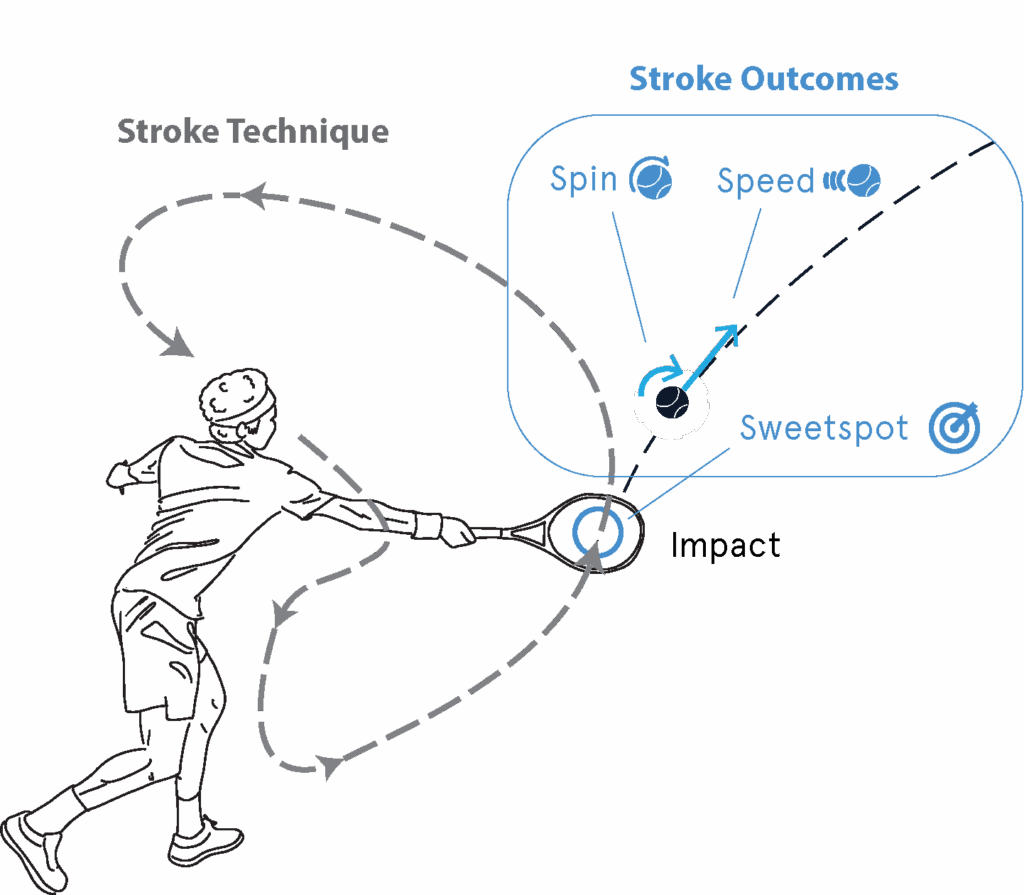
Stroke Primary Outcome Metrics
The stroke primary purpose is to redirect the ball and create a success ful shot. The stroke primary outcomes are attributes that describe the success of the stroke.
Ball Speed
Ball speed represents the linear speed of the ball as it leaves the racket.
Pace is measured in meters per second (m/s) and is divided into High, Medium, and Light.
Ball Spin
Spin represents the rotational speed of the ball as it leaves the racket. Spin is measured in rotations per minute(rpm).
Spin levels are divided into three regions: Topspin, Slice, and Flat.
Having strong topspin is a characteristic of modern tennis, and enables accurate shot control.
Sweet Spot %
Sweet Spot %is the percentage of strokes that have an impact location within the sweet spot.
SweetSpot% = number of strikes within sweet spot / total number of strikes
Proficient players have sweet spot % values into the 90th.
Stroke Architecture Overview
Understanding these phases is useful because it helps pin point characteristics critical for training.
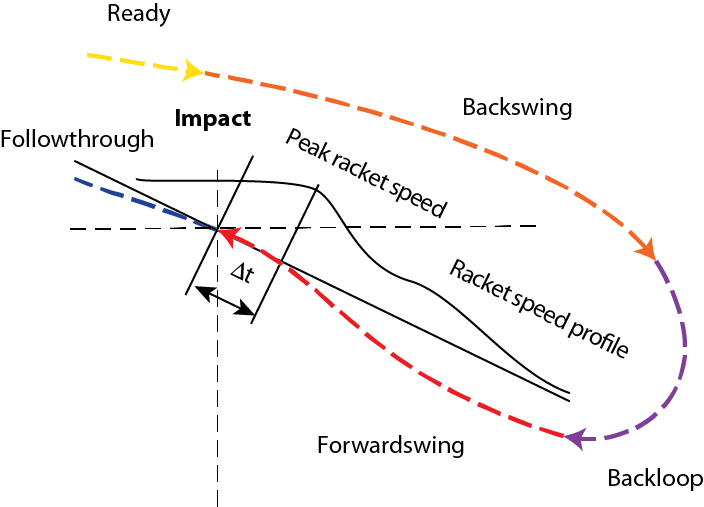
The stroke is organized in distinct phases. Many stroke technique metrics focus on specific aspect of a stroke phase, such as the racket face openness at the end of the back swing.

The figure illustrates the phases extracted by the CueMate motion processing.
Phases Before Strike
The phases are defined as follows:
- Ready: The racket is ready for the next stroke. It is the phase before initiating the backswing
- Backswing: Movement used to take the racket back.
- Back loop: Transition phase between the backswing and forward swing. This is a critical phase since it sets up the racket for the forward swing.
- Forward Swing: The racket is accelerating toward the ball. Key phase since it creates the impact conditions for the stroke outcomes.
Strike or Impact Phase
Impact (or Strike): Time period during which the racket is in contact with the ball. During the impact, the racket imparts part of its momentum to the ball and creates the outcomes.
Phases After Strike
Follow through: The racket is slowing down after impact. This phase provides information about the stroke technique.
Strike Metrics
Strike metrics focus on attributes of the phase when the racket strikes the ball.
The variation in the point of impact on the racket.
A high impact precision corresponds to a concentrated impact distribution.
While a low impact precision corresponds to a scattered distribution, and is often associated with a lower sweet spot percentage.
Impact Timing
Impact Timing refers to the time difference between the instant racket strikes the ball and the instant when the racket reaches its peak speed.
It allows to determine if you accelerate your racket through the impact or if you slowed down before the impact.
Impact timing can take:
- Negative values, indicating early timing (not hitting through the ball).
- Positive values hitting through the ball, and if large being late.
Ideally, impact timing should be small (less than 10msec): - Small impact timing (< 10 msec) indicates a good anticipation, preparation and timing of the stroke acceleration toward the incoming ball.
- Large impact timing (both the positive or negative values) suggest poor preparation and coordination of the stroke with the incoming ball.
The impact timing % is the analog to the sweet spot % but in the temporal dimension.Ideally, you want to keep your impact timing within a band around the strike time.
Together, the sweet spot area and the target impact timing describes an ellipsoid spatiotemporal region for a successful ball strike.
[NEW ILLUSTRATION]
Stroke Technique Metrics
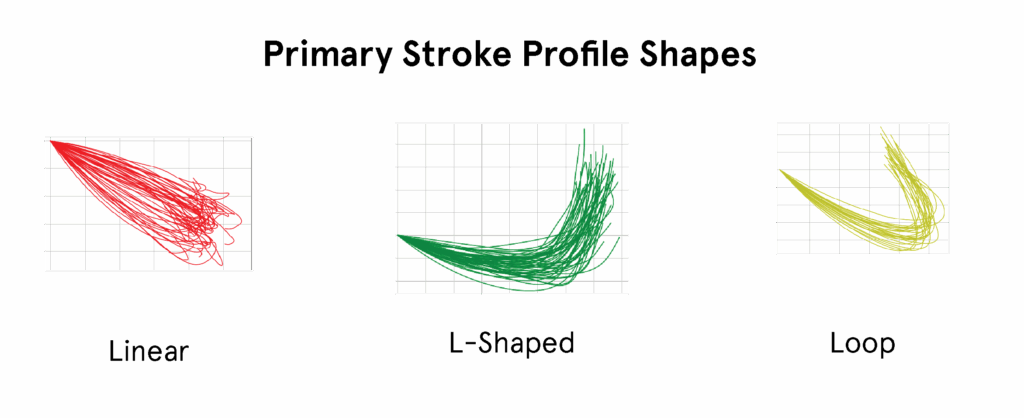
Swing profile geometry
- The curvature of the stroke during the forward swing phase
- The swing path angle before the ball strike
- Etc.
Racket configuration features
- Orientation of the racket face at various stroke phases, e.g., back loop openness, describes if the racket face is open, neutral, or closed at the end of the back loop phase.
- Etc.
Overall movement feature
- Size of the forward swing phase
- How far a player drops their racket during the back loop phase
- Etc.
Kinematic or dynamic characteristics of the racket motion
- Acceleration
- Angular rate
Smoothness
Smoothness measures the continuity of the stroke movement acceleration profile.
Players with higher movement skills have more continuous and less jerky movements.
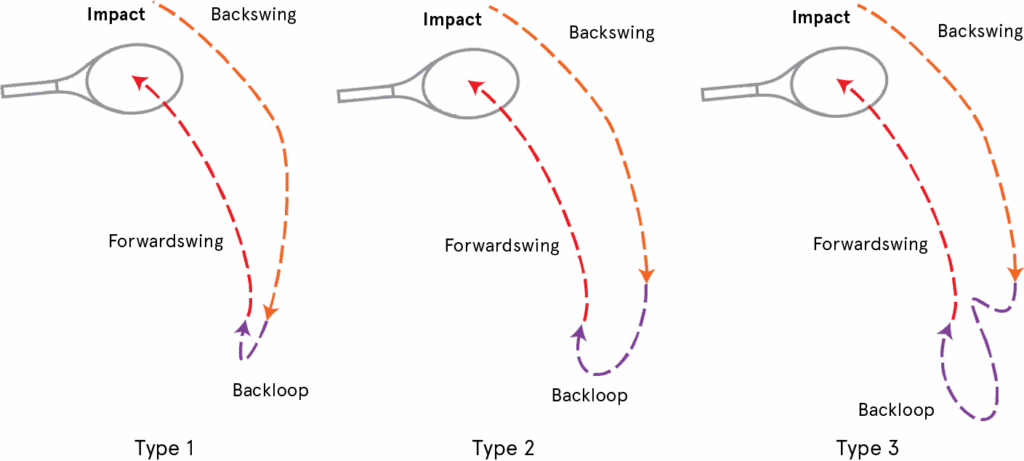
The back loop refers to the transition from the backswing to the forward swing (see stroke architecture illustration). The style of back loop is an important feature of the stroke technique.
Type 1: Linear transition from backswing to forward
Most of the momentum of the forward swing is created from scratch. Therefore it is physically more demanding and can put stress on the shoulder.
Type 2: Circular transition
Advantage of the conservation of the movement from the backswing to the forward swing.
Type 3: Circular transition with added lag
Builds on the Type 2 but the stroke goes through an additional loop before the forward swing.
Racket Drop
The Racket Drop refers to the angle of the racket path relative to the horizontal just before the ball strike.
[Note: need to update figure with renaming AoA as racket drop]
The deeper the racket drop the more vertical racket movement before the strike, helping to generate top spin.
The arc length refers to the length of the forward swing segment. It is basically a measure of how large the backswing is. The further back you bring the racket before the strike, the longer the forward swing path. Modern stroke technique uses much more compact strokes and shorter backswing and forward swing than the classic technique.
Stroke Physical Performance Metrics
Energy
Energy is the total amount of work performed by your muscles in a stroke, i.e., how much force is applied over the stroke duration.
Energy is measured in calories.
Power
Power is the average time rate of energy exerted during the forward swing. It is a measurement of the explosiveness of your stroke, i.e., how fast you release the energy into the stroke. Power is measured in watts.
Stroke Technique Coefficients
The coefficients (cE) are designed to capture efficiency of the stroke in producing outcomes.
Spin cE
Describes the efficiency with which the stroke technique produces spin. The higher the spin cE the less energy is required to produce a given amount of topspin.
Pace cE
Describes the efficiency with which the stroke technique produces speed. The higher the speed cE the less energy is required to produce a given amount of speed.
Spin-Speed cE
Describes the efficiency with which the stroke simultaneously produces spin and speed. Spin and speed are difficult to produce simultaneously because they rely on what can be considered orthogonal movements (the swinging motion for speed and the racket rolling motion for spin).