Feedback Cuening
The brain learns faster and better with immediate feedback.
Why Cueing?
When you are learning new movements or training to improve an existing movement, your brain is easily overwhelmed by the amount of information it has to keep track with.
A key information to make learning more efficient is knowing if what you are doing is right.
The literature on movement learning distinguishes between two types of feedback:
- The knowledge of performance: did my movement use the right technique or form.
- The knowledge of result: did my movement achieve the right outcome, e.g., the amount of spin or speed, the shot quality, etc.
CueMate provides this type of feedback using different cue forms and types.
Cue Forms
Cueing uses sound and verbal feedback generated during your stroke execution.
- Sound cues are based on tones that are designed to communicate information about your stroke performance in an intuitive way.
- Verbal cues use speech to communicate specific information about your stroke performance.
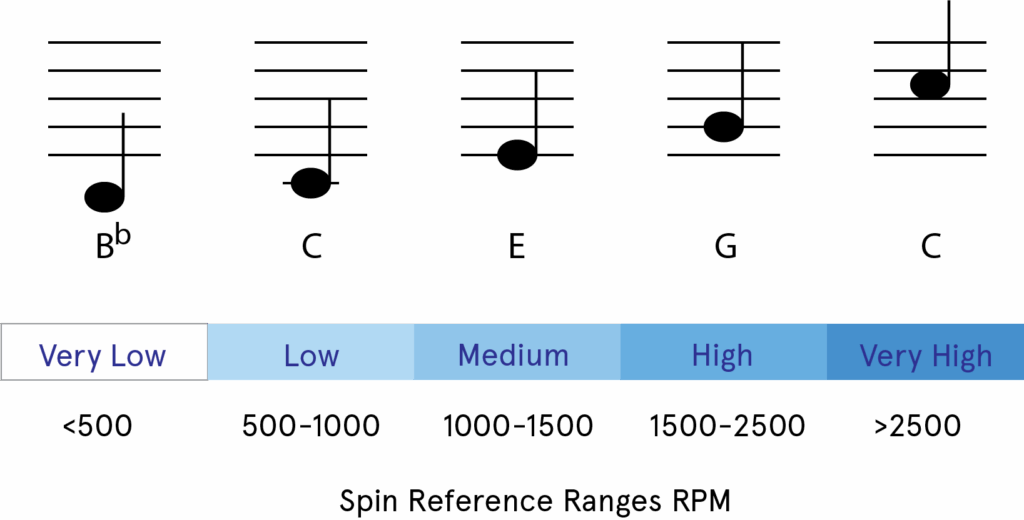
Sound cues are based on five tones to indicate the magnitude from very low to high. The tones are based on the reference levels they simply map the five levels to five tones as shown here for spin:
- Verbal cues are straight spoken words. For example, your speed “46 MPH” or spin outcomes “1870 RPM”.
Cue Types
The cueing features are organized in general cues, training cues, and instructions.
#1 General Cues
General cues are designed to provide general feedback focusing on the stroke outcomes independent of the stroke class. You can select to get feedback on spin, speed, or sweet spot.
General cues can be communicated both in verbal and sound forms.
#2 Training Cues
Training cues are associated with training goals and therefore focus on specific aspects of the stroke technique.
Training cues can be communicated both in verbal and sound forms.
#3 Instructions (in development)
Future cueing will also include cue words to remind you of the critical aspects to focus on. The cue words will be attached to training goals.
Instruction cues are communicated in verbal form.